A blockchain is a record book that thousands of computers keep copies of and none of them can quietly change. Bitcoin's is the oldest one still running: its first block is dated 3 January 2009, and every block since then is still there for anyone to download and check. This guide explains the four parts that make such a record possible, what the word “immutable” really promises, and the jobs a blockchain is a poor fit for.
The problem it solves
Digital things are easy to copy. That is fine for a photo and fatal for money: if a coin is only a file, nothing stops you from sending the same file to two people. Banks solve this by keeping one ledger that they alone can write to. You trust the bank to subtract from your balance when you pay, and the bank trusts nobody.
A blockchain solves the same problem without the single keeper. Everyone who wants to can hold the whole ledger, everyone checks every entry, and the rules for adding a page are built so that cheating costs more than it can earn. Nobody has to be trusted, because everybody can verify.
What is inside a block
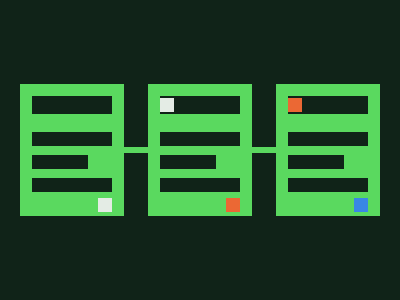
A block has two parts. The body is a list of transactions: in Bitcoin, usually a few thousand payments. The header is a short summary, 80 bytes long in Bitcoin, that contains a timestamp, one fingerprint that covers every transaction in the body, and the fingerprint of the previous block's header.
That last field is the whole trick. Because each block names the one before it, the blocks form a chain in a fixed order, back to the first one. Bitcoin adds a block about every ten minutes; Ethereum adds one every twelve seconds.
Hashes: the fingerprint that makes tampering visible
The fingerprints are produced by a hash function. You feed it any amount of data and it returns a fixed-size number, 256 bits in Bitcoin's case, usually written as 64 characters. Three properties matter here:
- The same input always gives the same output.
- Changing a single character of the input gives a completely different output.
- You cannot work backwards from the output to the input, or find a second input with the same output, in any practical amount of time.
Now follow what happens if someone edits a payment in an old block. The fingerprint of that block's transactions changes, so its header changes, so its own hash changes. The next block still stores the old hash, and no longer matches. To hide the edit, the forger has to rebuild that block and every block after it, and do it faster than the rest of the network is adding new ones.
Who keeps the record: nodes
A node is a computer running the network's software. A full node downloads every block, checks every transaction against the rules (does this coin exist, has it been spent already, is the signature valid, is the block the right size) and refuses anything that fails. It asks nobody's permission and takes nobody's word.
This is where the phrase “no single point of failure” comes from. There is no head office to raid and no master copy to corrupt. A node can vanish and the others will not notice. It is also why the rules are hard to change: an upgrade only happens if the people running nodes choose to install it. Our report on the BIP-110 split shows what happens when a small group of nodes adopts rules the rest ignore.
How strangers agree: consensus
If anyone can propose a block, the network needs a way to pick one when two arrive at once. That method is the consensus mechanism, and there are two main families.
In proof of work, used by Bitcoin, a block is only valid if its hash is below a target, which can only be achieved by trying billions of variations. Finding one takes real electricity, and checking one takes a millisecond. When two versions of the chain exist, nodes follow the one with the most work behind it.
In proof of stake, used by Ethereum since September 2022, validators lock up coins as a deposit. One is picked to propose each block and the others vote on it. A validator caught signing two conflicting blocks loses part of the deposit.
Both make rewriting history expensive. They differ in what the expense is, and our comparison of proof of work and proof of stake goes through the consequences.
What “immutable” really means
Nothing in the software forbids changing an old block. What stops it is cost. Each block added on top of yours is another block an attacker would have to redo, so the chance of a reversal shrinks quickly with depth. This is why an exchange waits for several confirmations before it credits a Bitcoin deposit: one block can be replaced by accident when two miners find blocks at the same moment, and six in a row essentially cannot.
So “immutable” is a statement about economics. On a large network such as Bitcoin, the hardware and energy needed to outpace everyone else put a rewrite out of reach. On a small chain with little mining or staking behind it, a rewrite is a known and repeated attack.
What a blockchain is good at, and what it is not
| Works well when | Works badly when |
|---|---|
| Several parties who do not trust each other must share one record | One organisation already controls all the data |
| The thing being tracked lives on the chain itself, like a coin or a token | The record describes something in the physical world that someone has to type in |
| Anyone should be able to audit the history | The data must stay private |
| A few transactions per second and minutes to settle are acceptable | You need thousands of writes per second or instant, free updates |
The second row deserves a moment. A blockchain can prove that an entry has not changed since it was written. It cannot prove the entry was true when it was written. A shipment logged as “organic coffee, 500 kg” is exactly as honest as the person who logged it. This is why most of the supply-chain and voting projects announced over the past decade never left the pilot stage, while money-like uses, where the asset exists only as entries on the chain, kept growing.
Four common misunderstandings
“Blockchain is anonymous”
Most blockchains are the opposite: every transaction is public forever. What is missing is a name. Addresses are pseudonyms, and once one is tied to you, through an exchange account for example, your history can be read by anyone. Chains built for privacy, such as Zcash, work differently; see our Zcash report.
“The data is encrypted”
It is not. The data is signed and hashed, which proves who authorised it and that it has not been altered. Anybody can read it with a block explorer.
“A blockchain cannot be hacked”
The ledger of a large chain is very hard to forge. The things around it are another matter: exchanges, wallets and the programs deployed on the chain are attacked all the time. Our research reports take apart several such thefts, and in none of them was the chain itself broken.
“Blockchain and Bitcoin are the same thing”
Bitcoin is one blockchain with one job, moving bitcoin. Ethereum and others also run programs called smart contracts. Companies run private chains among known members, which keep the data structure but give up the open membership that makes public chains hard to control.
Frequently asked questions
Who controls a blockchain?
Nobody in the way a company controls a database. The rules are enforced by every full node separately, miners or validators order the transactions, and developers can only propose changes. A change takes effect when the people running nodes install it.
Can data on a blockchain be deleted or corrected?
Not in practice on a large public chain. An entry can be superseded by a later transaction, but the original stays in the history. This is a reason not to put personal data on a public chain.
Is a blockchain just a slow database?
For a single owner, yes, and an ordinary database is the better tool. A blockchain trades speed for something a normal database cannot offer: a record that competing parties can share without any one of them being in charge.
Do I need to run a node to use a blockchain?
No. Most wallets talk to nodes run by someone else. Running your own means you verify everything yourself instead of trusting those answers, and on Bitcoin it works on a modest computer with a large disk.